Bariatric as a word essentially means ‘medical treatment for weight’. As a term, it comes from the merging of two Greek words: ‘baros’ meaning weight and ‘iatrics’ meaning medical treatment.
The science of bariatrics is more concerned with the Body Mass Index (BMI) of the person concerned, rather than just weight which needs to be considered in relation to other body measurements – such as height and stature.
Where a BMI of 10-20% is considered healthy, a person classed as ‘overweight’ will have a BMI ranging from 20% to the morbidly obese at 40+%.
There are also people who have a bigger than average build, that is, being tall and physically larger in size than an ‘average’ person and while possibly not considered overweight, may also have great difficulty using mobility aids and equipment which is generally available. They may need to select from a bariatric range of mobility disability aids and equipment.
This article does not include information or advice on the causes, possible treatment, or specific care of people who fall within the bariatric range. Rather, it seeks to be of assistance to both large and heavy people, their family and carers, who are looking for mobility aids and equipment to improve their day to day comfort and make getting around home and/or in the wider community a lot easier.
Before discussing particular categories of bariatric aids and equipment, it is necessary to be aware of the various considerations specific to larger and heavier people. It could be wise to consult a physiotherapist or occupational therapist to help decide on the best and safest solutions including the selection of appropriate mobility equipment based on areas of need and possible risk activities.
Other than medical needs like diet and skin care, such things as getting to and from medical facilities and obtaining emergency assistance can be determining factors. The size and shape of the bariatric person, their living environment, their movement capability, the risk to and capability of the carer(s), all play important parts in the proper selection of bariatric aids and equipment.
Proper skin care is essential for health and hygiene, especially in difficult to reach places and in skin folds. Using a bath is often not possible.
Body shape of the user will affect any equipment choice to achieve comfort and support needs. There are different requirements for a person who is short and pear shaped (weight on the hips and thighs) compared to a person who is tall and apple shaped (weight round the trunk).
The bariatric person may have limited movement caused by muscle weakness, pain from overstressed joints, or breathlessness, requiring assistance in and out of bed, washing toileting, and general daily activities. Preventative measures need be taken to reduce development of pressure ulcers caused through inactivity and poor circulation.
Home layout and the location of the main rooms e.g. bedroom, toilet and bathroom, and living room together with doorway width, may not suit bariatric aids and equipment. Steps and stairs make entry and egress difficult, if not impossible for wheeled movement. Rooms need to be large enough for equipment to be manoeuvred and still allow safety and free movement of carer. Storage space for temporarily unused bariatric equipment must also be adequate and easy to get at.
Generally, unless an elevator is available, a multi level residence is impractical; where it is absolutely necessary, then the floor weight bearing capacity needs to be carefully assessed in advance.
For carers, a full risk assessment should be done to identify problems such as difficulties moving and handling a heavy person, the level of risk caused both them and their charge, and the actions necessary to reduce that risk.
Most providers of rental mobility aids and equipment will have some products available which are described as ‘heavy duty’. These range up to about 140kg capacity. However, bariatric choices above that range are limited and expensive.
Many people are unable to afford to purchase bariatric equipment, so rental of bariatric aids and equipment is a viable alternative, especially considering the difficulty of selling the equipment at a later date, mostly at well below original purchase cost.
When choosing a bariatric aid, it must be strong enough to bear the user’s weight, be of suitable size and manoeuvrability for the caring environment, and optimised to make handling it and the user safe and as free of stress as possible for the carer. The carer (or carers) needs to be physically able and capable to manually handle a bariatric person.
Bariatric aids and equipment generally fall into four categories: bedroom, bathroom, seating, and mobility.
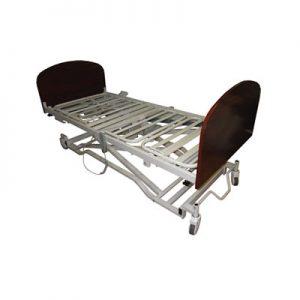
The choice of bariatric bedroom aids includes the bed and mattress system, bedside commode, and methods of lift and transfer to and from the bed.
A specially strengthened bed is essential for anyone whose weight exceeds 200kg. The bariatric bed may need to be purpose built for that person to accommodate both weight, height and/or body width. It will require that the bed mechanism be operated by an electrically driven raise and lower system to position the occupant, especially important for transfer out of the bed. The ability to raise or lower the bed to whatever is optimal for each requirement is of major importance.
These adjustable beds may also have sections which independently raise and lower the head and legs in various profiles. Additionally, some vertical profiling beds can tilt from horizontal to vertical to brings the user up into a standing position which enables them to step from the bed. Because of their raised height and large size, they may not be suitable for home use. Some profiling beds are able to raise into a full sitting position making possible to transfer from the end of the bed. Turning beds can turn the user from side to side automatically; or a mattress inclinator can assist someone to a sitting position.
Because transfer from and to the bed is often the most difficult procedure, there are a number of other aids which can be used, such as: bed blocks – which are used under the legs to raise the height of the bed; leg lifters – to lift the legs up to bed height so the person can roll onto the bed; bed poles – which are either overhead, or placed under the mattress to provide leverage when attempting to stand or reposition on the bed; bed transfer boards and sliding sheets – to assist the carer in moving someone from (for example) bed to wheelchair and vice versa.
Where a conventional mattress is used it needs to be firm enough so the occupant does not sink into it, making it very difficult to position them, or be unable to use the bed surface as a firm base when attempting to sit or stand. A hospital mattress is ideal for this purpose, being specially made to provide a firm surface.
To treat or prevent pressure ulcers (also known as pressure sores, bed sores, or ‘decubitus ulcers’) a pressure care mattress system, or an alternating pressure overlay on top of the mattress, should be used. These systems are designed to relieve pressure on sensitive body parts such as hips and upper legs through lying in one position for extended periods; alternately deflating and inflating a series of air cells, to achieve this purpose.
Another method of transfer, often used in the bedroom, is a hoist and sling system. The system can be a mobile hoist or an overhead hoist.
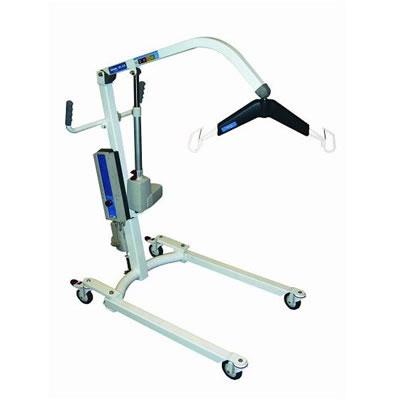
Mobile hoists are used to lift people who are unable to take weight through their legs, and to move them. They are commonly used in nursing homes and aged care facilities and require special skill and care to ensure patient safety.
These patient lifters have a large footprint and require space for manoeuvring and a storage area when not being used. Other than lifting a person from bed or wheelchair, they can also be used for showering and toilet needs. Special slings have been designed with particular uses in mind. When used in the home environment the carer must be properly trained to use and maintain the hoist.
Where possible, and especially for longer term care, an overhead hoist system is preferable. These hoists can be mounted on a ceiling track or from a wall to wall beam, or as a free standing gantry hoist. Ceiling and wall mounted hoists will be dependent on weight bearing of the structure, and they are limited to the reach area of the installation. The free standing gantry hoist is portable, and usually easily dismantled for transport.
The type of sling to be used will depend on the person’s size, weight, size and weight distribution. For example, someone with the bulk of their weight around the hips and thighs (pera-shaped), will require a sling with long leg sections. Because some sling fabrics can be abrasive, people with poor skin condition may need additional lining protection.

Where the toilet facility is too distant for easy access, it may be preferable to use a bedside commode. These are usually disguised with at least a pull down top and skirts to hide the collection pan underneath the seat. Some models have adjustable height arm rests which are removable or lift out the way when necessary.
Alternatively, a mobile commode may be used. This has the advantage it can be available when needed, but stored when not required. Even better, a combination mobile commode and shower chair, is more practical as it reduces the number of equipment items.
You can get an attendant propelled mobile commode chair, an attendant propelled mobile shower chair commode chair or a self propelled mobile commode chair or self propelled mobile shower chair commode chair, made from steel, aluminium, or stainless steel for improved strength.
These mobile bathroom and toilet chairs are interchangeable as bathroom aids.
Most homes have standard size bathrooms and toilets, that is, generally too small for the larger person especially when mobility aids for bathroom and toilet are necessary. Modifications may be needed to accommodate the disability equipment.
A heavy duty shower stool is of value for sitting on when washing at a handbasin, or for waiting while the carer prepares the shower. These are available with armrests. A bath transfer bench can also be used for this purpose.
The heavy duty bath transfer bench acts as a resting medium between hoist, wheelchair, or mobile shower or commode chair and the bath or shower. It can also substitute for a shower chair, or be used to sit on in a bath tub where a hand shower can be used, so it is very versatile and an immediate choice where space is limited. Where extra stability is needed a bariatric heavy duty shower chair is another alternative.
A mobile shower chair, mobile commode chair, or a combination mobile shower and commode chair allows the user to prepare for their shower in a more spacious area such as the bedroom, to be wheeled through to the shower.
Where the user is reasonably mobile a heavy duty bath board is available for use in a bath. This is adjustable to fit most bath types and widths and allows the user a means of easing into the bath or using it as a platform for hand washing or a hand held shower spray.
The user’s weight or size may stress the average WC unit, and it may be necessary to utilise a heavy duty toilet aid. There are a few different types available.
Whilst there are a number of ways a standard toilet bowl can be altered to provide more comfort and better support there needs to be adequate space around the WC for this purpose. A bariatric over the toilet aid (raised toilet seat) can improve seat height, but the size of the seat is usually the same as a standard WC seat so it still may not be suitable for the larger person.
Where there is risk of weight damage an an issue of personal safety, particularly if the existing toilet facility cannot be altered, then it may be best that a bariatric commode or bariatric mobile commode chair be used instead.
People with a lot of weight around their stomach and thighs are more likely to be comfortable with an angled backrest. A high backrest which can recline provides greater comfort when sitting. For this reason a reclining mobile commode chair or a float in space commode chair may be considered.
For bathing, toileting, or showering a number of bariatric grab rail options are available to provide support and make standing or sitting easier. These can be mounted on the bath itself, on the walls of the facility or hang from the ceiling. Probably the most secure is a floor and ceiling mounted support pole, which may also have a horizontal support rail attached.
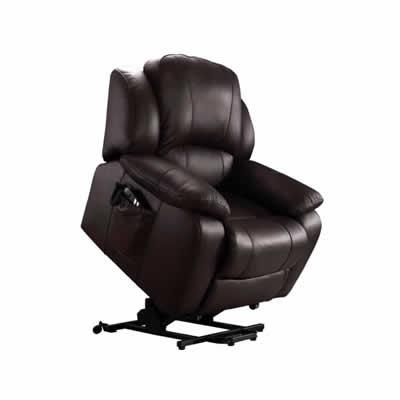
When choosing a suitable bariatric chair for relaxing, either in the bedroom or lounge area, the weight and shape of the person, the amount of time sitting, and other equipment necessary in support (e.g. hoist, or tables) needs to be considered.
The chair should be comfortable and supportive for chair-based activities such as reading and watching TV, and any special hobbies the client may have. Often, for heavier people it will need to be custom built. For those people who have difficulty standing from a sitting position a bariatric lift recline chair or bariatric mechanical lifting device may be used. These can be spring assisted or powered.
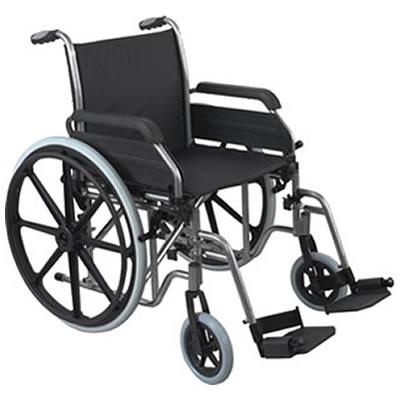
These include bariatric rollators, bariatric wheelchairs and bariatric walking aids. All of these aids are essentially the same as standard equipment except they will be built from stronger and heavier materials and strengthened to suit the purpose. Bariatric mobility aids are invariably more expensive to buy or hire for this reason.
More information about Bariatric Equipment & Aids can be found here
Copyright – Mobility Rentals & Sales 2016